One system to crack any Samurai Sudoku board
The biggest difference between regular Sudoku and Samurai Sudoku is not the number of cells — it is the way you need to look at them. This page gives you a complete solving rhythm from opening to endgame, so 405 cells stop feeling like an ocean of noise.
Start every board with this sequence
This is not a rigid formula — it is a proven launch sequence. Follow it for a few boards and it will naturally become your own rhythm.
Spend 30 seconds surveying the full layout before placing anything
Identify which overlap boxes have the highest given density and which corners have the fewest empty cells. This brief scan finds the best entry point for the entire board and keeps you from diving into a low-value zone.
Begin your first deduction inside the densest overlap box
In the overlap with the most givens, check digits 1 through 9 one at a time. If any digit has only one legal position left, that is your first confirmed placement.
After every placement, trace its propagation path
Which rows, columns, and boxes did that new digit affect? If it was inside an overlap, jump to the other board immediately — your next confirmed digit is very likely hiding there.
When stuck, reroute through the center grid
Do not spin your wheels in the same spot. Pull your attention back to the center grid and look for a breakthrough through a different overlap channel. One new center placement can unlock an entire stalled region.
Close each round with a 10-second cleanup pass
Delete outdated candidate marks and re-examine the overlap boxes that changed. This small habit prevents information overload and makes your next round sharper.
Run through these 5 lines before every board
You do not need to memorize every tactic on this page. Just review these five lines before you start, and your solving efficiency will jump ahead of aimless scanning.
Start with the overlap boxes — begin at the densest one.
After every overlap placement, jump to the other board immediately.
Two passes through a corner with no progress — switch to the center now.
Only mark candidates in cells with 2–3 remaining options.
Spend 10 seconds after each round clearing stale notes to keep the board clean.
Two diagrams that show how information actually flows across the board
Samurai Sudoku is not five separate puzzles glued together — it is one massive information network. These two diagrams show you the critical nodes and propagation paths. Understand them, and you will always know where to look next.
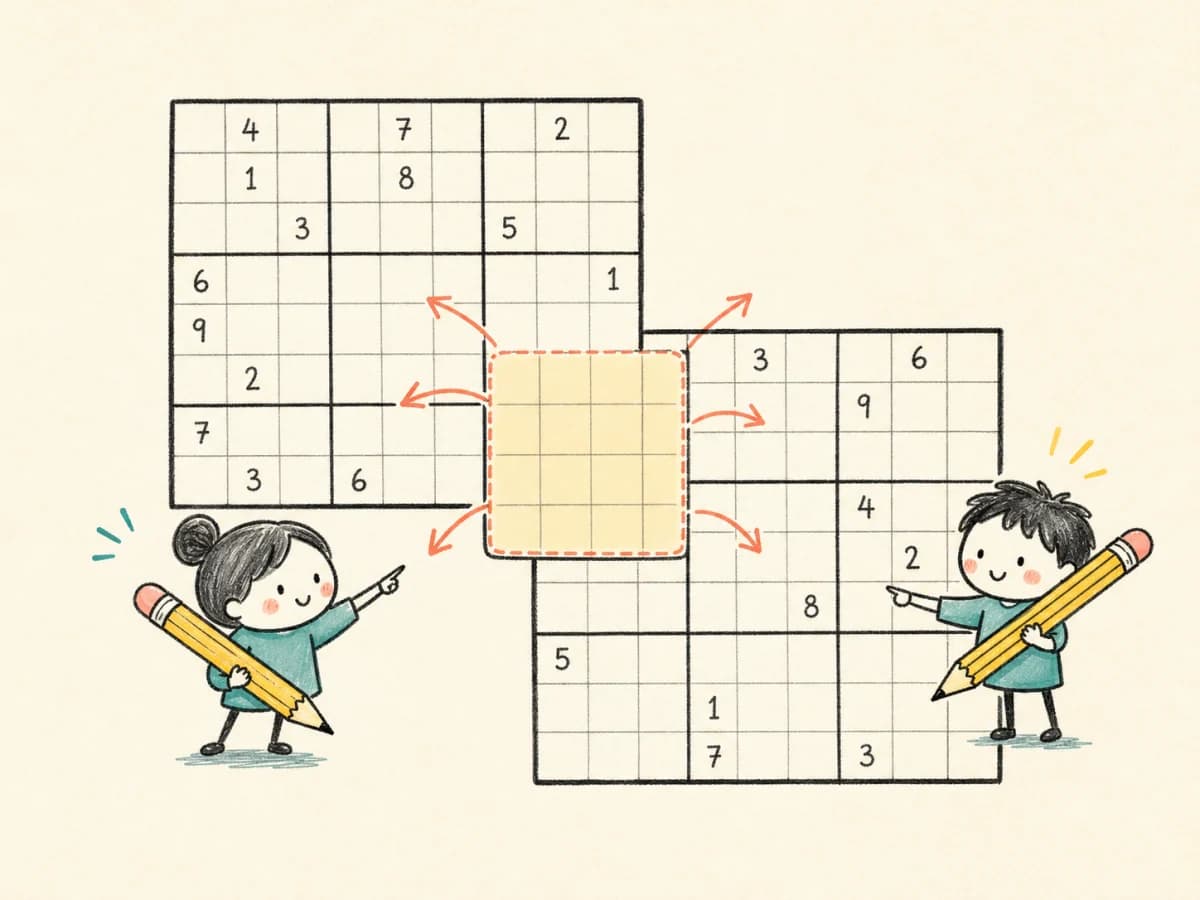
Overlap boxes: one move, two boards benefit
An overlap box is a 3×3 region shared by two boards. When you confirm a digit here, the effect ripples outward like dominoes — updating rows and columns on both boards simultaneously.
This is why overlap boxes are the highest-leverage spots on the entire puzzle. One minute of thinking in an overlap produces roughly twice the progress of the same minute spent on a peripheral edge cell.
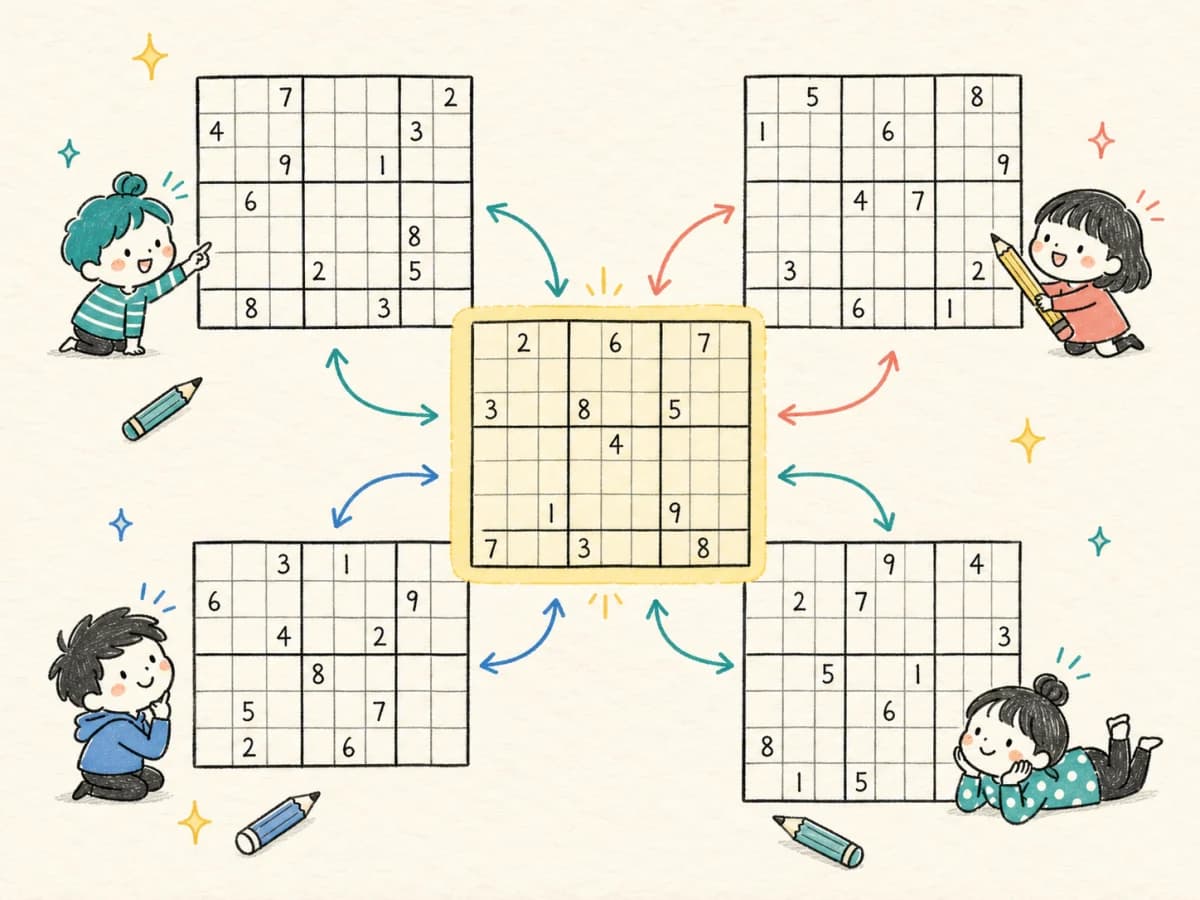
The center grid: traffic hub for the entire puzzle
The center grid connects to all four corner boards. When one corner stalls, the fastest solution is usually not inside that corner — it is a detour through the center, using a different overlap channel to funnel fresh information back.
Once you internalize this routing, getting stuck stops feeling like a dead end and starts feeling like a signal to take a different path.
Master these three and you will never feel lost on a Samurai board
Each tactic below solves a different problem: the first teaches you where to start, the second shows you how to break out of a stall, and the third keeps your board readable throughout the entire solve.
These 4 bad habits are silently slowing you down
Most players are not beaten by difficulty — they are beaten by their own attention management. See if any of these sound familiar.
Starting from the top-left and scanning row by row
That is a standard Sudoku habit and it completely misses the highest-value overlap zones. Your first look should land on the four overlap boxes, not the upper-left corner.
Placing a digit in an overlap and staying on the same board
You just created a fresh clue for the other board. If you do not check it, you are throwing away the biggest structural advantage Samurai Sudoku offers.
Grinding a single corner for more than three minutes
If two passes through a corner produce nothing new, that corner needs external information. Switching to the center grid is far more productive than staring harder.
Treating candidate notes like a diary — filling every cell to the brim
Excessive notes create massive visual noise and bury the critical changes you need to spot. Restraint is efficiency.
Watch a full Samurai Sudoku solve in under 4 minutes
Everything you just read becomes a visible, moving process in this video. Watch how an experienced player fluidly switches between overlap boxes, corner boards, and the center grid.
How to Solve a Samurai Sudoku (Step by Step Guide)
A compact 3.5-minute video that walks through a complete Samurai Sudoku solve. Best used as a motion reference after reading the tactics above.
Notice whether the first move targets an overlap box rather than a random corner.
Watch for the immediate board switch after each overlap placement.
Spot the moments when the solver deliberately retreats to the center grid to break a stall.